
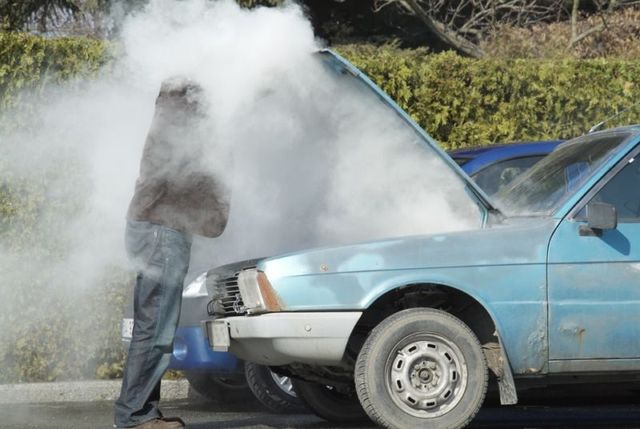
It is always good practice to keep an eye on your instrument panel so that you become aware as soon as the temperature gauge starts to rise.
What to do when you notice the temperature gauge rising1
Consider switching off the air conditioner and opening up the windows, this will reduce the demand placed on the engine, and allow it to cool down. Turn on the heater, as this will withdraw heat from the engine bay.
Briefly rev the engine1
Should you notice the temperature rise in heavy traffic, place the gear into neutral or park, and slightly rev the engine. This speeds up the fan and water pump , causing more liquid to pass through the radiator, which in turn cools the engine.
Should I brake often? 1
Avoid braking too much as it places a demand on the engine as you accelerate back up to speed, thus heating it up. You can achieve this in heavy traffic by travelling slowly at a slightly faster than idle speed, instead of racing and braking excessively.
When to park your car and switch off the engine1
If your coolant pipe begins to leak suddenly, the cooling efficiency drops drastically. The temperature needle may move quickly into the red zone. This will be the time to find a safe parking spot and immediately switch off the engine.
What should I do next? 1
With the engine off, carefully open the bonnet, making sure it is not too hot to touch. Leave the engine to cool for a good 30 minutes and check the coolant level.
Is the coolant level where it should be? 1
An engine that overheats usually means that the cooling system is failing because of insufficient coolant. A low coolant level can cause this, it could also be due to a sudden leak starting in the cooling system.
Where can I check the coolant level? 1
Most modern cars have a coolant reservoir or bottle, which has some clear lines marked on it near its cap. If the coolant level is acceptable, then the temperature gauge could be faulty. If the coolant reservoir is quite empty, it will be time to call for roadside assistance.
What if I need to keep going? 1
Once the engine has cooled down, wrap your hand in a towel or equivalent and open the coolant reservoir cap and radiator cap. Refill either with coolant or water if no coolant is available.This should lower the engine temperature but be on the alert of any sudden change in temperature while travelling, especially if the coolant leak has become worse. You do not want to case more damage to your vehicle from driving your car while it is overheating.
Prevention is better than cure1
Regularly check the coolant level in your car, and in this way, you may be able to detect if a leak is starting or not. The coolant level will gradually drop anyway over time due to evaporation. Always make sure you are adding the correct coolant for your make and model car.
Now that you know how to handle an overheating car and look after its coolant level, make sure you have access to roadside assistance via your car insurance policy. Are you looking for more affordable car insurance? Why not make further enquiries with PMD regarding their affordable car insurance?
This article was prepared by Eric Sandmann in his personal capacity. The views and opinions expressed in this article are the author’s own. The views and opinions in the article should not be attributed to anyone but the author unless expressly stated. Nothing in this article should be relied upon as advice, this publication is presented for informational purposes only. No person should act or refrain from acting in reliance on any information found in this article, without first obtaining proper financial advice from the appropriate professional. The author makes no claims, promises or guarantees about the accuracy, or completeness, of any information linked from, referred to, or contained in this article. The author reserves the right, to edit and change the content of this article.
Source:
1https://www.iol.co.za/motoring/industry-news/what-to-do-if-your-car-overheats-1944166